
On 'Wuthering Heights'
Or, what' we've got wrong about "The Greatest Love Story of All Time"

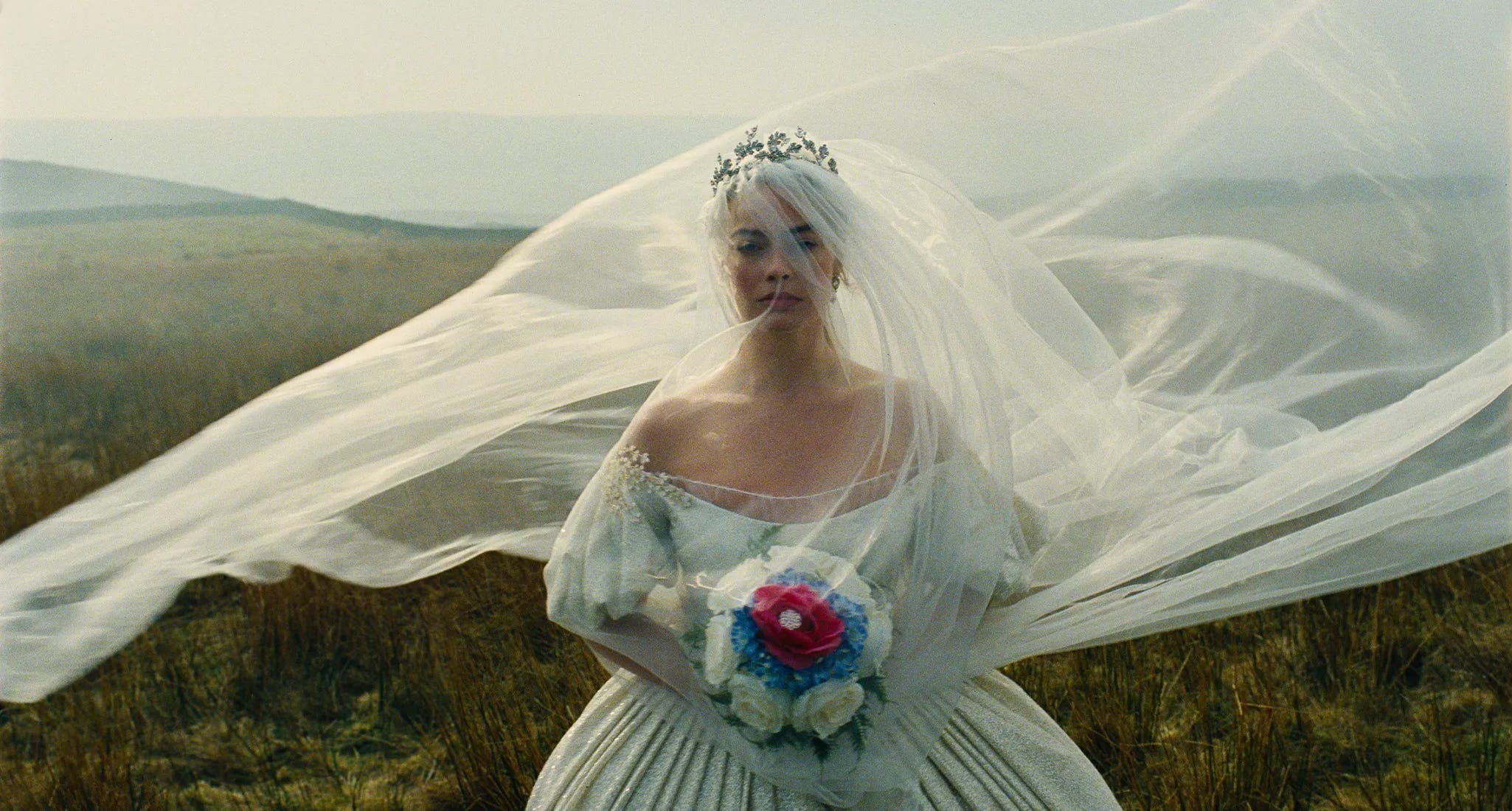
The words flashed on the screen as a veritable symphony crescendoed over the black-and-white montages. “The greatest love story of our time—or any time!” it proclaimed. Such was the stream of title cards for the 1939 adaptation of Wuthering Heights starring Laurence Olivier and Merle Oberon. Emily Brontë’s 1847 Gothic family saga has held this reputation ever since. Thus, it was not surprising that the 2026 adaptation, directed by auteur and provocateur Emerald Fennell, gave itself the same billing. Months and months of trailers and imagery told me she was leaning not on Brontë as the source material but the Golden Age of Hollywood (including, strangely, a reference to Gone With the Wind???)
For those unfamiliar with one of the greatest works of English literature, Brontë’s gothic drama of love and tragedy is an intergenerational tale positing two young lovers at its center: Catherine Earnshaw and Heathcliff. The latter is found, presumably an orphan (or even a slave) in Liverpool by Catherine’s father, and brought to Wuthering Heights as a child. The pair are raised as adoptive siblings, which evolves into infatuation and love as they grow older.
Wuthering Heights has a lone neighbor in Yorkshire moors, a sumptuous property called Thrushcross Grange. It is the home of the Lintons, who have two children, Edgar and Isabella. Brontë’s novel follows these families as they intertwine through marriages, births and deaths, all set in motion because of the love triangle between Catherine, Heathcliff and Edgar. It is ultimately a revenge tale as Heathcliff seeks to destroy the legacies of those he feels wronged him.
Fennell, like the Hollywood powerbrokers before her, has latched onto the idea that Wuthering Heights is a love story. I hate to break the news, but it’s not. I’m not even sure it could be deemed romantic. That is, unless one is into the sado-masochism that permeates the novel. Yes. The first time I heard Fennell & Co. drop that term in an interview, I scrunched my nose. But after a careful second read of the text, I realized that she’s not wrong.
In the film, it’s best illustrated in the portrayal of Heathcliff and Isabella’s relationship, which some are saying is inappropriate and goes too far. Yes, it is completely dehumanizing, disturbing, and unsettling. People are right to condemn it. Close reading of the source material, though, leads me to believe that, if not the best interpretation, Fennell’s vision is a possible interpretation, when Heathcliff says:
“The first thing she saw me do, on coming out of the Grange, was to hang up her little dog, and when she pleaded for it, the first words I uttered were a wish that I had the hanging of every being belonging to her, except one: possibly, she took that exception for herself—But no brutality disgusted her—I suppose she has an innate admiration of it, if only her precious person were secure from injury! Now was it not the depth of absurdity of genuine idiocy, for that pitiful, slavish, mean-minded brach to dream that I could love her?” (Wuthering Heights, page 150)
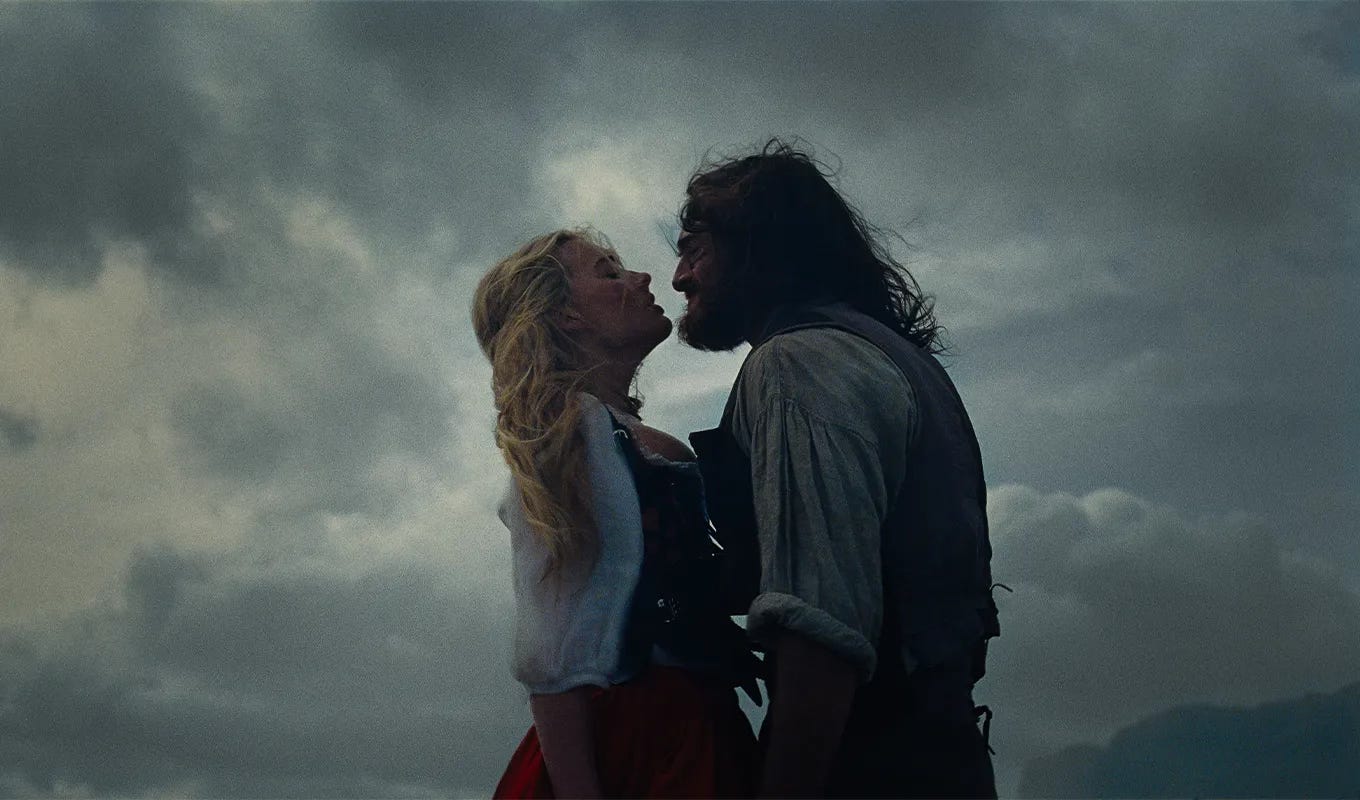
It is fundamentally imperative to understand that Wuthering Heights is a gothic novel—expecting a sanitized love story à la Jane Austen would be to completely miss the point. Emily Brontë ultimately wrote an intergenerational revenge plot that was deemed “morally transgressive” in its time.
Therefore, dubbing the book “the greatest love story of all time” misses the entire mark—erasing the deep and complex dynamics between the characters and the ultimate story arc. Yes, Catherine and Heathcliff are the fateful lovers, but Wuthering Heights is not their story. Wuthering Heights is Heathcliff’s story. In centering the narrative around this man, Brontë was an iconoclast. Because, unlike many of the film adaptations, Heathcliff is “dark almost as if it came from the devil,” “a dirty, ragged, black-haired child,” a “gipsy brat” and “little Lascar, or an American or Spanish castaway.” He is racially ambiguous at best, but definitively not Caucausian. Heathcliff himself is also quoted as saying, “I wish I had light hair and a fair skin, and was dressed, and behaved as well, and had a chance of being as rich as he will be!”
For context, the year that Wuthering Heights was published (1847) was just 14 years after England abolished slavery and seven years after British slave owners ceased the practice of retaining former slaves as unpaid “apprentices.” The novel’s present day is set in 1801-1802; the story of Catherine and Heathcliff said to have taken place 25 years earlier, meaning the bulk of the events would have started around 1776. During this period, Liverpool, the city in which Heathcliff had been found, is still a huge port for the European slave trade.
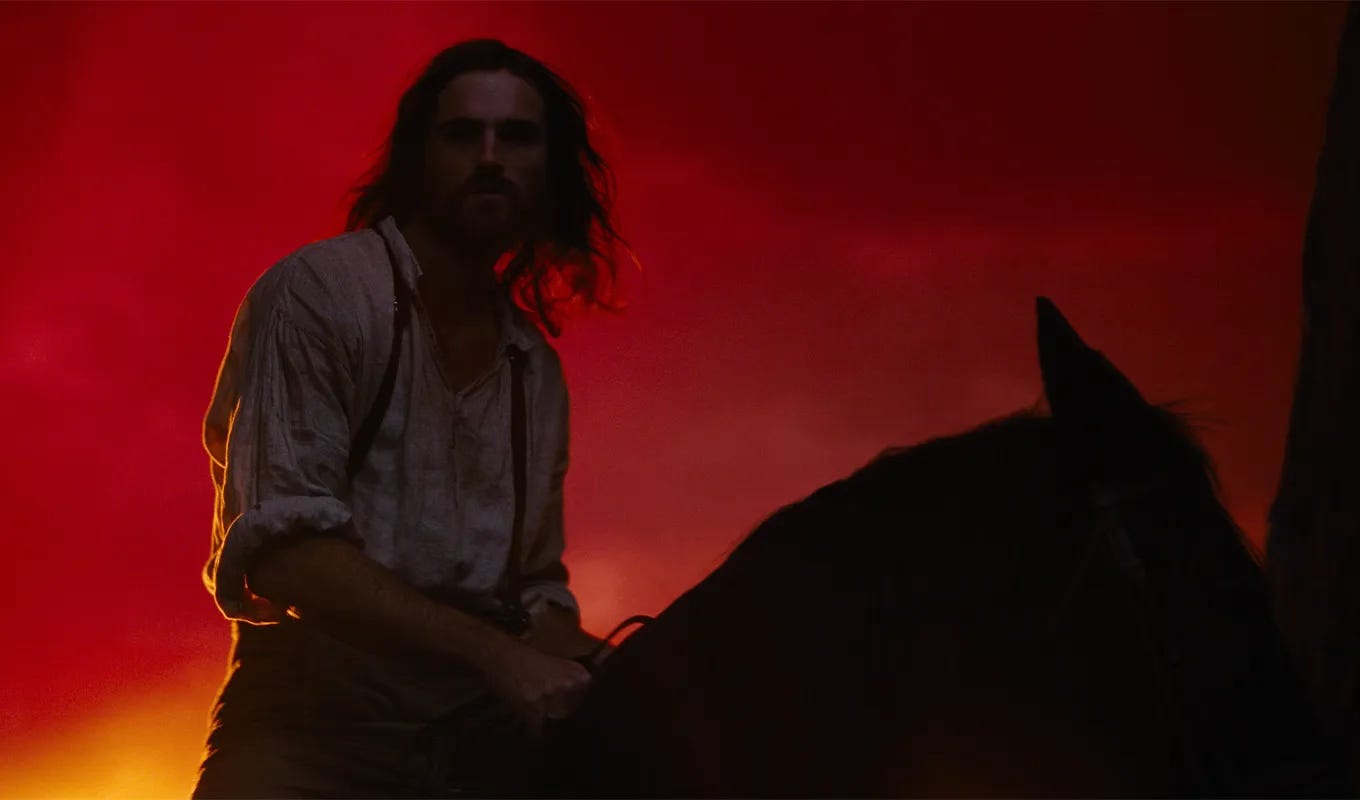
Thus, as the protagonist (or, with the amount of violence he commits, rather the anti-hero), Heathcliff has much to overcome. Dehumanizing treatment from his adopted family, the loss of his lover to a man more privileged and respected than he will ever be, constantly despised and doubted...in a quest for vengeance, Wuthering Heights transforms from a simple story of tortured lovers into a sweeping family saga that looks at the darkest corners of the human soul. Brontë addresses thorny topics like social class, race, feminism and religion in a way that literary scholar John Burton noted was breaking not just narrative norms, but moral ones as well.
However—despite, in spite of all of this, Fennell has maintained that “Wuthering Heights” is her experience reading the novel when she was 14. So, essentially, she set expectations that this would not be a faithful adaptation. This was always going to be a smutty teenage fan fiction fever dream.
Smutty it was. The opening scene lays the groundwork for what is an incredibly sensual, sexual, sinister undertone. You’ve seen the trailers: Bread dough, egg yolks, a sweating back looked at in ways you can’t unsee. The tension is there, and it’s taut. Fennell even goes so far as to imply BDSM in one scene. I’m not sure that any of this was necessary, but it is effective in setting this baseline for brutality that is relentless until the fade-out.
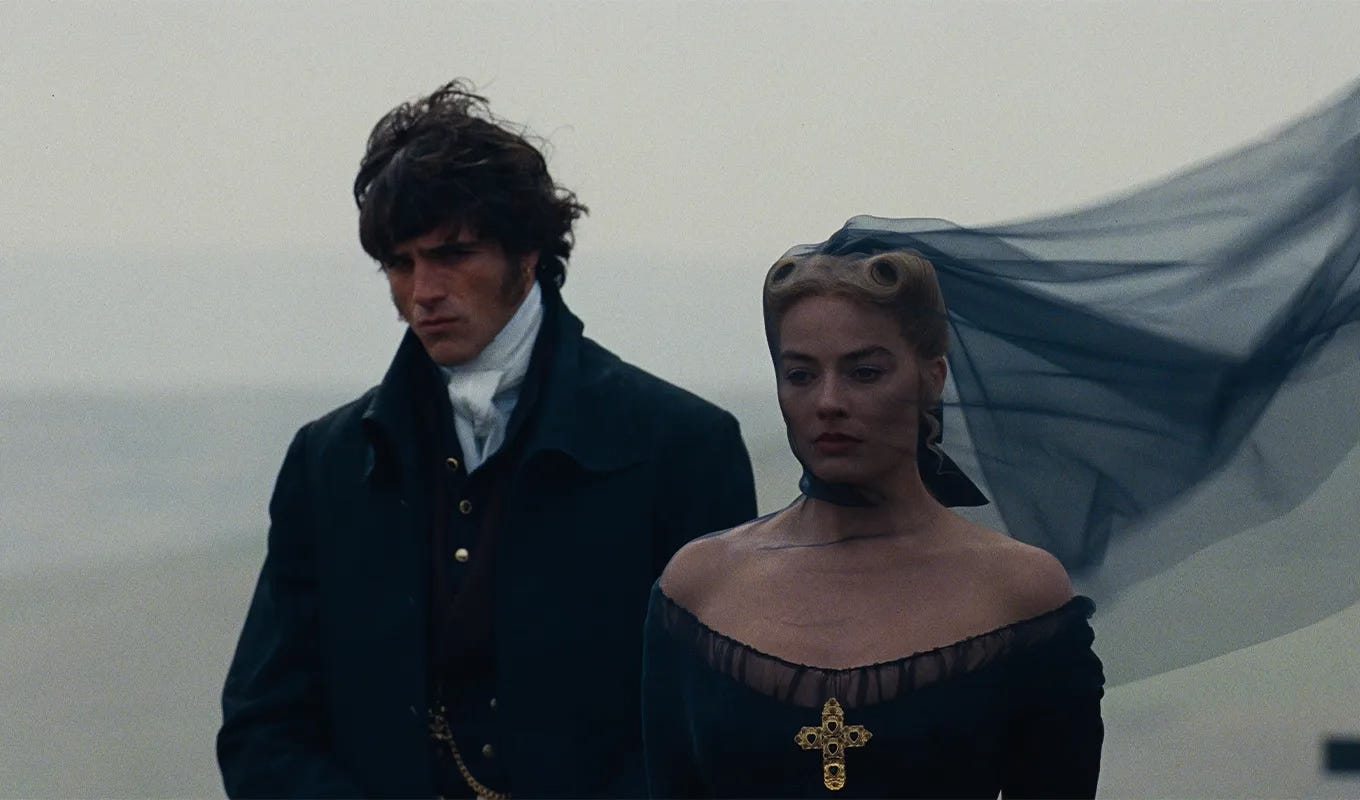
While there was a lot of sexual content (is it an Emerald Fennell movie if there isn’t?), I was surprised at how...chaste everything was rendered. There’s also the commendable fact that nothing really happens until at least halfway through the film. The characters have to earn it; they’re not just thrown together as quickly as possible. I think that in this way, Wuthering Heights did accomplish something that people love about period dramas. The yearning is intense, as it should be. In the book, Heathcliff says of Catherine after losing her to Edgar: “If he loved with all the powers of his puny being, he couldn’t love as much in 80 years, as I could in a day.”
It’s true that there is a litany of ills: The abused Yorkshire accents (this honestly did not bother me), inaccurate (though sumptuous) costumes, contemporary soundtrack, miscast leads, on and on. But use this as a barometer would be to hold the film to something it was never going to be. Yes, Fennell’s Wuthering Heights is wildly inaccurate. I could almost visualize a 14-year-old Emerald Fennell in her bedroom, furiously typing away on a Compaq computer while a ‘90s punk girl band played on the boom box—she would have been 13 in 1998, the year that FanFiction.net hit the world wide web. But she has said repeatedly that this is her interpretation. Nothing’s going to change that.
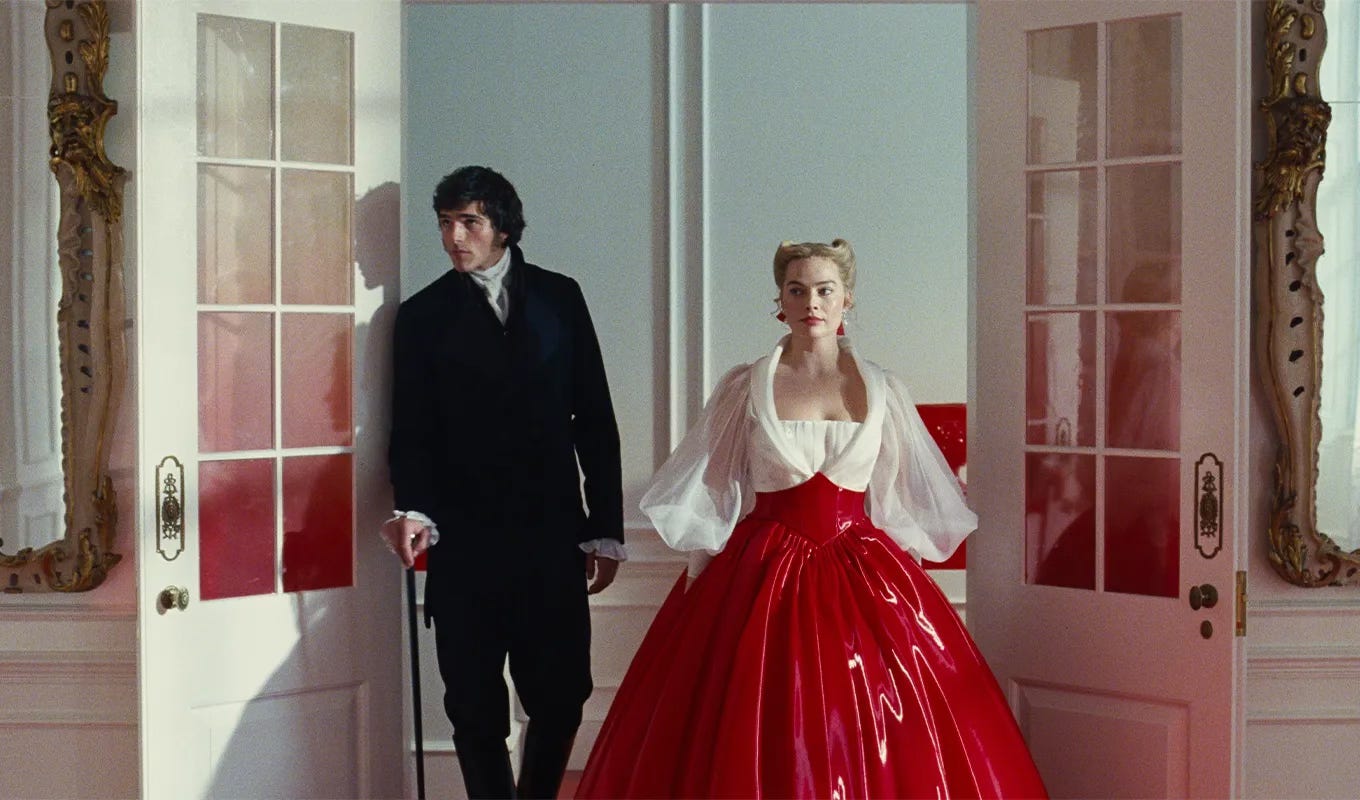
Truthfully, only a TV series could do Wuthering Heights justice. Fennell's rendition cuts at the halfway point, though in her defense, she wasn't the first to do it. The film, from its references to the Golden Age of Hollywood to its plotting and pacing, was eerily similar to the 1939 movie. Fennell even mentions this adaptation in interviews. But a two-part series for each half of the novel would allow us to appreciate it for what it actually is: A revenge saga.
I'm not saying that Wuthering Heights should win any major awards, but I am saying that for what it set out to be (reminder: 14-year-old smutty fan fiction fever dream), it hit the mark. Evaluating it for what it's never going to be is a moot point. More importantly, if watching the film or simply following the drama surrounding it piques people's interest in the source material, I'll take that as a win, considering that over 50 percent of Americans didn't open a single book last year.
It’s easy to get swept up in the impossibly romantic lines—“Be with me always—take any form—drive me mad! Only do not leave me in this abyss, where I cannot find you!”—I certainly did. But underneath is a text brimming with a jagged complexity and mastery that, dare I say, even Jane Austen did not attain.
This originally appeared on PureWow in two articles:
All photos credited to Warner Bros. Pictures.
What I’m Reading
Chaos Monkeys: Obscene Fortune and Random Failure in Silicon Valley by Antonio García Martínez
Tippi: A Memoir by Tippi Hedren
Margo’s Got Money Troubles by Rufi Thorpe
Not Quite Dead Yet by Holly Jackson
How to Walk Away by Katherine Center
What I’m Writing
Confession: I Read the Most Popular Book on Goodreads and Cried My Eyes Out
I’m Obsessed With ‘You’ve Got Mail’—Minus This Enormously Problematic Plot Point
10 Enchanting ‘Wuthering Heights’-Coded Airbnbs Nestled in the English Moors
This Must-Watch Film Has a 91% Rotten Tomatoes Score—But Was Totally Snubbed for Awards Season
I’m Coming to Terms with Always Being in One-Sided Friendships